


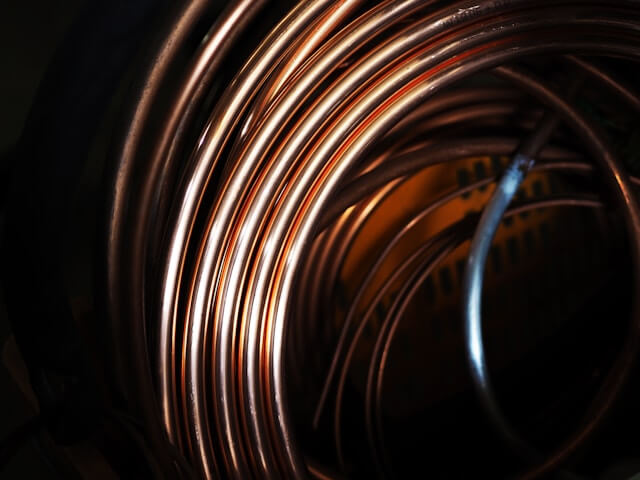
The fundamental role of copper wires in electrical systems goes back more than a century. No less crucial for engineers to understand, however, is that copper wiring like that found in RS Online’s cables and wires range continues to be indispensable in today’s ever-more electrified world.
From powering homes and offices to supporting electric vehicle (EV) infrastructure and renewable energy projects, copper’s unique combination of qualities means it is often still the material of choice for dependable, efficient, and safe electricity transmission.
A Quick History of Copper Wiring
Copper has been declared “man’s oldest metal”, having been discovered by Neolithic man around 9,000 years ago. This material’s potential usefulness was soon apparent to our ancestors, who noticed it was much easier to shape than stone.
Fast-forward an (extremely) long way to the 19th century, and the copper industry boomed on the back of the increasing use of electricity.
Charles Wheatstone and William Cooke patented one of the first commercially successful electric telegraph systems using copper wire in 1837. When Thomas Edison developed a commercially practical incandescent lighting system in the late 1870s, copper was used to carry the current to it.
Why Copper Is Still Widely Used for Electrical Wiring
To this day, copper remains the global standard for electrical wiring and systems. The primary reason for the metal’s sustained dominance in this regard is its exceptional electrical conductivity. Among metals, copper ranks second only to silver in this sense, but it is much more practical and cost-effective.
The use of copper wires in an electrical system ensures electricity can flow with minimal resistance. This goes a long way to reducing energy losses and heat generation. Such efficiency is as crucial as ever in 21st-century infrastructure, given that even small losses can accumulate significantly across power grids, buildings, and devices.
Other major advantages of copper wiring include:
- Its high ductility and malleability. Copper wires can be drawn into thin strands and bent without losing conductivity. This allows for easier installation in tight spaces such as homes, lofts, and wall cavities.
- Its thermal conductivity. Copper’s effective dissipation of heat helps minimise the risk of overheating in circuits.
- Its corrosion resistance. The lack of iron in copper means it doesn’t rust. Instead, it withstands moisture and humidity by forming a protective oxide or patina layer that generally preserves long-term durability and conductivity better than many alternatives.
- Its safety. In the context of regulations around the world that focus on minimising fire risks in electrical systems (such as BS 7671 in the UK), it is advantageous that copper has a high melting point, in addition to being resistant to creep (gradual deformation under pressure).
- Its recyclability. Copper can be recycled repeatedly with minimal loss of performance characteristics. This greatly supports the net-zero ambitions of countries around the world.
Yes, aluminium is lighter than copper, and it does sometimes see use in high-voltage transmission for cost reasons. However, it only has about 61% of copper’s conductivity, which means larger cross-sections are required for the same current.
It is copper, then, that delivers particularly impressive performance in connections and smaller installations. Unsurprisingly, this means it is still the standard for building wiring in parts of the world like the UK.
The Applications of Copper Wires In 21st-Century Electrical Systems
Copper wiring is used across a multitude of projects and settings in contemporary life, such as:
- Power distribution and building wiring. From the national grid to domestic sockets, copper can be counted on for efficient delivery with minimal losses.
- Renewable energy. Amid the ongoing expansion of renewables, copper is valued for the efficiency it brings to solar photovoltaic (PV) installations and wind farms, including in inverters, cabling, and connections.
- Electric vehicles and charging. High-performance copper cables can handle the demanding currents in EV chargers and vehicle wiring.
- Data and communications. Fibre optics are the go-to choice for long-haul applications during the 2020s. However, copper (often in twisted-pair or coaxial forms) retains a key role in Ethernet, broadband, and in-building networks.
- Industrial and electronics. The formidable reliability of copper wiring means it continues to be widespread across modern motors, transformers, control systems, appliances, and consumer devices.
Copper Wires Look Set for Continued Strong Demand in The Years Ahead
Even while electrical technology keeps on advancing, at least one thing stays the same: copper’s central role in many of the latest electrical systems.
In large-scale applications, alternative materials such as aluminium are sometimes favoured. Copper, though, still enjoys a dominant status as a wiring material for projects and settings where performance, reliability, and safety are critical.
Indeed, high-performance copper cabling is likely to see even greater demand over the years ahead, as new projects utilising emerging technologies, such as smart grids, renewable energy systems, and automation, continue to come on stream.
So, if you’re reading this while attempting to narrow down your options for such specialised products, you might find that copper wiring is still the right choice not just for your present installation, but also for your other projects over many years to come.
