


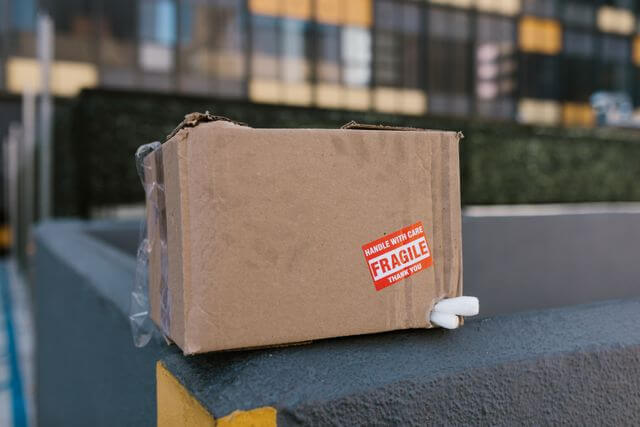
A parcel comes back with a crushed corner and a customer service ticket attached, and somewhere in the business a spreadsheet records it as a returns cost. It is filed under logistics, or fulfilment, or occasionally under the courier’s name. It is almost never filed where it belongs, which is under a decision somebody made about a box, probably eighteen months earlier, probably on price.
Corrugated is the least expensive component in most shipments. It is also the component with the widest gap between what it costs and what it costs you when it fails, and that gap is where a surprising amount of margin quietly goes.
Corrugated is not one material
The board is three layers: an inner liner, an outer liner, and a fluted medium sandwiched between them. That fluting is the engineering. It is what turns flat paper into a structure that resists compression, and its profile changes what the box can do.
C-flute is the standard shipper, offering a workable balance of stacking strength and cushioning. B-flute is shallower and takes print better, so it appears where a shipper also has to look like something. E-flute is thinner again, used where a corrugated box needs to behave like a retail carton. Combine flutes, or move to double wall, and you gain strength and lose interior volume and cost efficiency.
None of this appears on a purchase order that says 300 by 200 by 150 millimetres, brown, quantity twenty thousand. And that is usually what the purchase order says.
The two strength tests measure different failures
Corrugated is specified against one of two standards, and the choice matters more than most buyers realise.
The Mullen burst test measures the pressure required to rupture the board. It describes resistance to puncture and rough handling, which is what a single parcel meets on a conveyor, in a van, on a doorstep.
The Edge Crush Test measures how much compression the board withstands on its edge. That describes stacking strength: what happens when the box sits at the bottom of a pallet under nine identical boxes for three weeks in a humid warehouse.
A box specified for burst strength and then warehoused in a stack will fail. A box specified for edge crush and then thrown by a courier may fail differently. The question is not which number is higher. It is which failure your supply chain actually produces, and most companies have never asked.
Oversizing costs twice
Carriers increasingly bill on dimensional weight, which charges by the volume a parcel occupies rather than the mass it contains. A box larger than its contents is therefore paid for on every single shipment, forever, in freight.
It is paid for a second time in void fill. Air pillows, paper, foam: all of it is material bought to compensate for a box that was the wrong size, and all of it is handled, stored, and eventually disposed of by a customer who did not ask for it.
And it is paid for a third time in damage, because a product that can move inside its box will move, and movement in transit is what breaks things. Void fill restrains that movement imperfectly. A correctly sized box removes the need for it.
Right-sizing is the single highest-return change available in most fulfilment operations, and it is almost always available, because most companies run three box sizes for two hundred products.
The shipper is now a brand surface
For anything sold direct, the corrugated outer is no longer a logistics component that the customer never sees. It is the first thing they see. It arrives at their door, is photographed occasionally, and is opened in a moment that the brand has spent money to create.
This is what has pulled corrugated into territory it did not previously occupy: printed outers, internal print, structured inserts made from board rather than plastic, tear strips that open cleanly. Executed well it is indistinguishable from premium packaging. Executed on a standard brown shipper with a sticker on it, it undoes whatever the product was supposed to communicate.
The businesses that solve this tend to have stopped buying boxes from a catalogue. Specifying custom corrugated packaging means choosing the flute profile against the real failure mode, sizing the box to the product rather than to a stock dimension, and having someone engineer the structure before it is printed. Manufacturers such as GUKA Packaging run that structural work in-house and on FSC-certified board, which matters increasingly to the retailers and marketplaces on the other end of the shipment.
Where to start
Find out what your damage rate actually is, by product and by lane, rather than as a single company-wide figure that averages a fragile item with a resilient one. Damage concentrates. So does the saving.
Measure the void in your most-shipped box. If the product occupies less than three quarters of the interior volume, you are paying dimensional weight on air and buying material to fill it.
Ask your maker which test your board is certified against and why. If nobody at either company can answer, that is the finding.
Then look at what happens to the box after delivery. Board that separates cleanly into a single material recycles. Board laminated to a film, or holding a moulded plastic tray, does not, and the retailers and regulators who care about that are multiplying rather than diminishing.
The economics are not subtle
A box that costs a few cents more per unit and eliminates a fraction of a percent of damage pays for itself immediately, and then keeps paying, because the replacement shipment, the return freight, the customer service time, and the review that follows a broken delivery are all costs that never appear on the packaging line of the cost sheet.
Corrugated rewards specification more than almost anything else a company buys, and it is bought with less specification than almost anything else. That gap is the opportunity. It has been sitting there, in brown, on every pallet, the entire time.
