


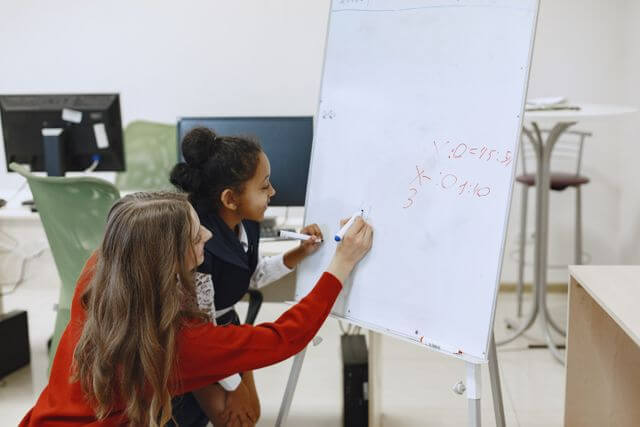
A mathematics classroom can contain students of the same age who are working from very different starting points. One child may solve multistep problems confidently while another still counts through basic calculations. A third may know the procedure but struggle to explain why it works. Teachers have to move all three through the same curriculum, often within the same lesson and against the same assessment schedule. That gap between classroom pace and individual readiness creates one of the hardest problems in mathematics education.
The problem rarely comes from a lack of effort by teachers or students. Mathematics builds progressively, so missed skills can affect later topics for years. Large classes, limited lesson time, varied learning needs, and pressure to cover required content make sustained individual attention difficult. In examining these challenges, we also share insights from an expert math tutor in Adelaide on why students can appear to keep pace for months before an earlier weakness finally becomes visible.
One Classroom Can Contain Several Mathematical Levels
Age and school year provide convenient ways to organize students, but they do not guarantee equal mathematical readiness. Two seventh graders may both study equations while having very different commands of fractions, multiplication, negative numbers, and order of operations. One can focus on the new algebraic idea. The other has to solve the algebra while simultaneously compensating for several weaker skills.
Teachers can differentiate work to a degree. They may group students temporarily, provide extension questions, adjust examples, or give targeted help during independent practice. The practical limit appears when too many students need different forms of instruction at once. A teacher cannot conduct six separate lessons simultaneously while maintaining classroom pace and preparing everyone for the same required content.
Parents often notice the gap later, when homework suddenly takes far longer, or test results begin dropping. At that stage, they may decide to find a tutor who can slow down, identify the exact missing skills, and rebuild them in sequence. The need for extra support does not automatically indicate poor teaching. It may simply reflect a mismatch between the pace available to one learner and the pace required by a full classroom.
Mathematics Makes Earlier Gaps Hard to Hide
Many subjects allow students to enter a new topic with relatively little dependence on last month’s content. Mathematics behaves differently. New concepts frequently rely on previous ones. Fractions support percentages and ratios. Arithmetic supports algebra. Algebra supports functions, statistics, and many areas of higher mathematics.
A student can sometimes conceal a weak foundation by memorizing procedures. They may learn that two numbers should be multiplied in one type of question without grasping why multiplication applies. This strategy can produce acceptable results while problems remain familiar. Once the wording changes or several concepts appear in the same question, memorization becomes much less reliable.
That is why a decline in performance can look sudden even when the original difficulty began years earlier. A child may appear comfortable with elementary mathematics, then struggle sharply when middle school work requires flexible calculation and multistep reasoning. The current lesson may receive the blame, although the real problem could involve earlier number relationships or fraction knowledge.
Effective support therefore needs diagnosis before additional practice. Giving twenty more algebra problems to a student whose fraction skills remain weak can increase frustration without addressing the source of the errors. A teacher or tutor needs to trace mistakes backward until the first unstable skill becomes clear.
Teachers Have Limited Time for Individual Diagnosis
Classroom teachers constantly make decisions about pace. Spending another day on one topic may help several students but leave less time for the next unit. Moving forward keeps the curriculum on schedule but can leave some learners with unfinished knowledge. Neither choice works perfectly for every student.
Individual diagnosis also requires time. When a student gets an answer wrong, the error itself provides limited information. The child may have misread the question, chosen the wrong operation, forgotten a fact, applied an incorrect rule, or made a small calculation mistake. Each cause calls for a different response.
A teacher working with one student can ask follow-up questions and inspect each step. In a full class, the same teacher may need to check many students, answer questions, manage behavior, introduce new material, and monitor independent work within a single period. Detailed error analysis becomes difficult to provide consistently for every learner.
Students who are quiet can become especially easy to miss. A child who disrupts the lesson or openly says they are confused attracts attention quickly. Another may copy examples carefully, avoid volunteering answers, and submit partially correct work. Their difficulty can remain less visible until formal assessments expose it.
Test Scores Can Show a Problem Without Explaining It
Schools need assessments because teachers need evidence of progress. The difficulty comes when a score becomes the main description of a student’s mathematical ability. A result of 62 percent tells a parent that many questions went wrong. It does not reveal one single reason behind those mistakes.
Error patterns give far more useful information. A student may perform well on calculations but struggle with word problems. Another may know the correct method yet make repeated arithmetic errors. Someone else may solve straightforward equations but fail when fractions appear. Looking at the pattern helps identify what kind of teaching should follow.
Timing can distort the picture too. Some students reason accurately but work slowly. Others perform poorly under test pressure despite stronger classroom performance. A student with fast recall may score well on routine questions while struggling when problems require explanation or unfamiliar reasoning. One number can hide these differences.
Parents can ask more specific questions after receiving a test result. Which question types caused difficulty? Did the student know how to begin? Were the errors conceptual or computational? Did the same mistake appear several times? These questions turn a score into information that can guide the next step.
More Practice Helps Only When It Targets the Right Skill
When a child struggles with mathematics, the instinctive response often involves more worksheets. Practice has value, but repetition works best after the learner has a workable method. Repeating a misunderstood process can make the wrong approach more automatic.
Targeted practice begins at the learner’s current level. A student struggling with percentages may need to revisit fraction-decimal relationships before completing more percentage exercises. Someone making frequent algebra errors may need stronger fluency with negative numbers. Once that earlier skill improves, the newer topic often becomes less demanding.
Short, regular sessions can work better than occasional long ones. Ten focused minutes on multiplication facts, fraction equivalence, or mental calculation can build fluency without turning every evening into another full school lesson. Parents can also use ordinary situations such as recipes, shopping, travel time, or household measurements to give numbers a practical purpose.
Feedback should stay specific. Telling a child to “try harder” offers little direction. Pointing out that they changed the denominator incorrectly identifies something they can examine. Asking them to explain a step can also reveal if they know the reason behind the method or simply copied a familiar pattern.
Closing the Divide Requires Better Matching of Support to Need
Schools cannot realistically provide one teacher for every student, so the solution depends on using available support more precisely. Early screening can identify weak prerequisite skills before they interfere with several later topics. Small-group instruction can then focus on students who share a specific difficulty instead of giving the entire class the same extra practice.
Flexible grouping can help as students’ needs change. A child may require additional support with fractions for several weeks and later return to standard classroom work. Another may need extension tasks in geometry while receiving help with algebra. Students do not fit permanently into simple categories such as “strong” or “weak” at mathematics.
Technology can provide useful practice and immediate feedback, although software works best as a supplement rather than a substitute for skilled teaching. A program can detect repeated incorrect answers, but a teacher can ask why the student chose that method, notice hesitation, and adapt the explanation in response. Human instruction remains particularly valuable when the difficulty involves misconceptions rather than simple lack of practice.
Progress should ultimately appear as greater independence. A student who once needed constant prompting should begin choosing methods alone. They should become better at checking if an answer looks reasonable, explaining their reasoning, and identifying where they became stuck. Those changes often reveal meaningful improvement before a dramatic rise in grades appears.
The mathematics divide inside schools does not come from one flaw that a new textbook, app, or teaching method can remove. It develops because students arrive with different knowledge, learn at different rates, and move through a curriculum that cannot stop indefinitely for every unfinished skill. Teachers work within those constraints every day.
Reducing that gap requires earlier diagnosis, more targeted instruction, realistic communication with families, and extra support when classroom time cannot meet a student’s needs. The goal should be to catch small gaps before they become larger ones. In mathematics, a missing skill rarely stays isolated for long. The sooner a learner receives help at the right level, the easier it becomes to reconnect with classroom work and move forward with greater confidence.
