


A supply chain can look strong on paper and still fail on the day one small part breaks. Most resilience plans focus on suppliers and shipping routes. Far fewer look at where the spare parts that keep operations running actually sit.
Location decides how fast a failed component gets replaced. A part that exists somewhere in the network but takes three days to reach the site does little for a team facing a stopped line or a grounded aircraft. Aviation maintenance shows this more clearly than almost any other industry, and the lessons apply well beyond airports and hangars.
What Makes Critical Spares Different From Regular Inventory
Regular inventory exists to be sold or consumed on a predictable schedule. Critical spares exist to be used rarely and urgently. A hydraulic pump or a specialized fastener may sit on a shelf for months, then become the most important item in the building within minutes.
That changes how they should be managed. Turnover rates and carrying costs still matter, but they are the wrong primary measures. The better question is what happens to the operation if the part is not available within hours. When the answer is a halted process, the part belongs in a different category with its own stocking rules.
Aviation Maintenance Shows the Cost of a Missing Part
Airlines use the term aircraft on ground, or AOG, for a plane that cannot fly because it is waiting on a repair. Every AOG event disrupts crew schedules and passenger bookings while taking a revenue-generating asset out of service. The part that caused it is often small and inexpensive compared with the aircraft it holds on the tarmac.
Because of that imbalance, maintenance organizations treat spare parts as a planning problem long before a failure happens. They study which components fail, how long replacements take to source, and how far each station sits from the nearest supply. Those answers drive where parts are stored.
Keep Parts Close to Where They Will Be Needed
A single central warehouse is efficient on a spreadsheet. It reduces the total number of units held and simplifies counting. It also puts every urgent request at the mercy of shipping times, customs, weather, and carrier cutoff hours.
Airlines and repair shops avoid grounded aircraft by keeping critical spares in aerospace storage near the point of need rather than at a single distant warehouse. The extra units held at each location cost money, but the cost is predictable. An unplanned stoppage is not.
Decide What to Stock Locally
Not every spare deserves a place at every site. Stocking everything everywhere ties up cash and floor space. A simple scoring approach helps separate the parts that must be on hand from the ones that can wait for delivery.
Four questions usually settle it:
- How long does a replacement take to arrive from the supplier?
- What does an hour of downtime cost if this part fails?
- How often does this component fail or reach the end of its service life?
- Does it have special storage needs, such as shelf-life limits or controlled conditions?
Parts with long lead times and high downtime costs are the strongest candidates for local stock. Parts that are cheap, common, and available overnight can stay at the central location.
Balance Central and Local Stock
The Central Hub
A hub holds the full range of spares, the slow movers, and the high-value units shared across several locations. It acts as the source for replenishment and the fallback when a local site runs out.
The Local Stocking Points
Sites closest to operations hold a smaller set of fast-response parts. Their stock levels should reflect local failure history rather than a company-wide average. A site that services older equipment may need deeper stock of certain components than a newer one.
Sharing information between the two layers matters. If a local site uses its last unit, the hub should know immediately and start replenishment before the next failure occurs.
Storage Method Affects How Fast a Part Reaches the Technician
Putting a part in the right building only solves half the problem. Someone still has to find it, confirm it is the correct revision, and get it to the work area. In a crowded stockroom with paper records, that can take longer than the repair itself.
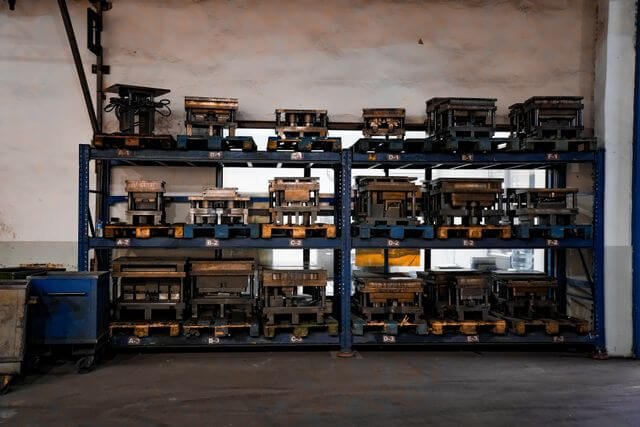
Many maintenance and warehouse teams address this with organized, traceable storage. Parts are assigned fixed locations, picked against a work order, and logged on removal. That reduces wrong-part errors and gives auditors a clear history. Automated storage and retrieval equipment can also shrink the floor space required, which makes it more realistic to add stocking points close to operations.
Build Visibility Into the Spares Process
Stock placed in the right locations still fails if nobody knows what is on the shelf. Reliable data replaces guesswork with a repeatable process. A few practices cover most of what a spares program needs:
- Real-time stock counts at every location, visible to planners across the network
- Usage history tied to the equipment or work order that consumed the part
- Reorder triggers set by lead time and failure rate rather than by a flat minimum
- Regular cycle counts that catch mismatches before they cause a shortage
Teams that track these items can spot patterns early. If a component starts failing more often, stock levels can rise before the shortages appear.
What Other Industries Can Take From Aviation
The same logic applies anywhere downtime is expensive. Manufacturers with single-line production, hospitals with imaging equipment, energy operators with remote assets, and fleet owners with tight delivery schedules all face the same question: which parts must be within reach, and where?
Aviation works as a model because it has been forced to answer this at scale, under strict documentation and safety rules. Businesses that borrow its habits, such as ranking parts by the consequence of failure and placing stock by response time, tend to recover faster when a breakdown does occur.
Resilience Is Settled Before the Part Fails
Suppliers and forecasts both matter, but they only work if the right component can reach the right place in time. Deciding where critical spares live is one of the cheapest ways to protect an operation. Review which parts would stop work if they failed tomorrow, check how far each one sits from the people who would need it, and move stock closer where the gap is too wide.
